
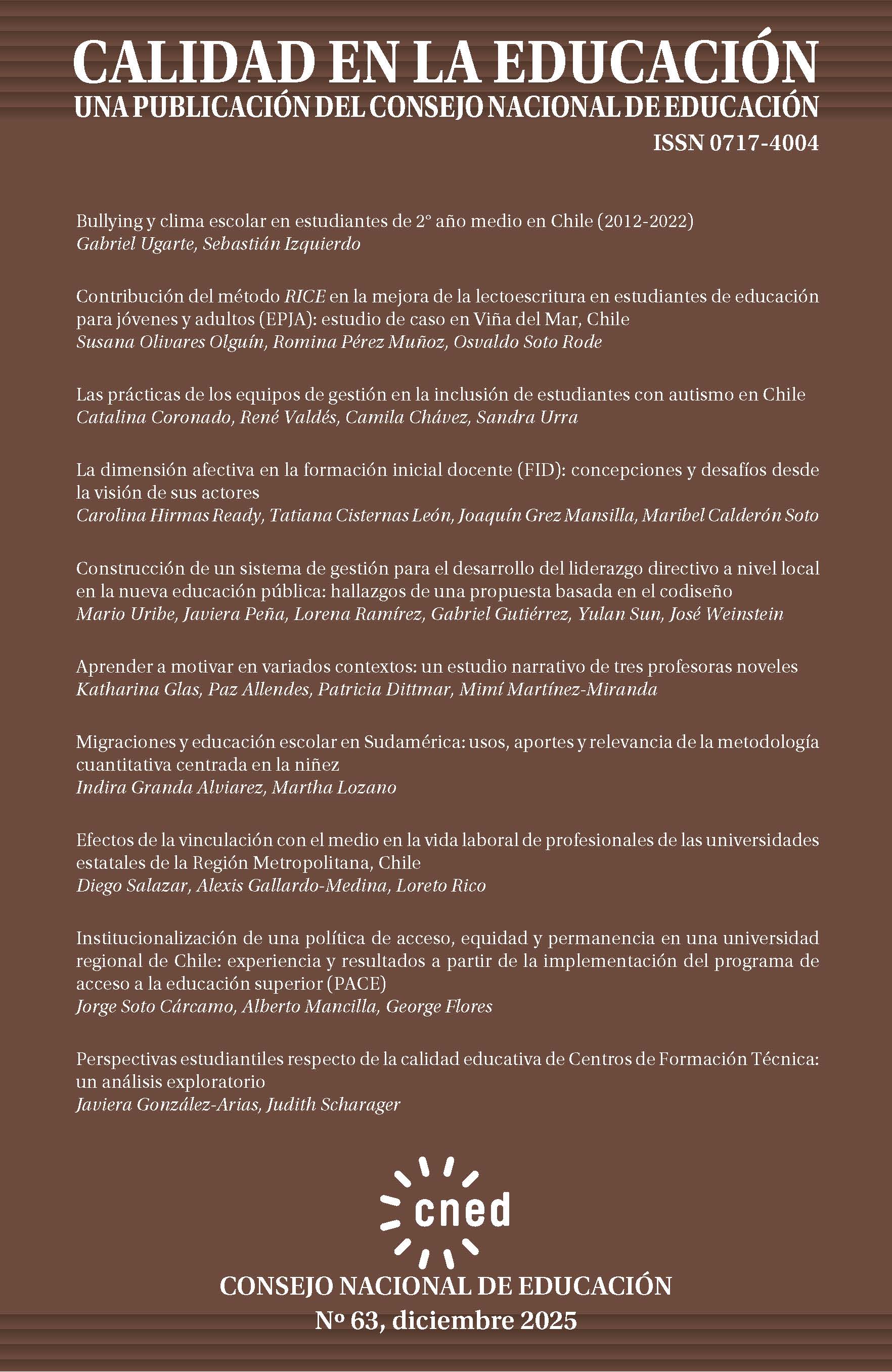
Effects of Community Engagement on the Working Lives of Professionals at State Universities in the Metropolitan Region, Chile
DOI:
https://doi.org/10.31619/caledu.n63.1644Keywords:
Comprehensive training, Higher education, Community engagement, Quality assurance, University outreachAbstract
In Chile, community engagement has become established as a university function in response to labor market demands, university commitment, and quality assurance processes. Academic literature has likewise centered its analyses on these same areas when examining the phenomenon, which has significantly outweighed the amount of research focused on the narratives of those directly affected. This study sought to narrow that gap by analyzing, from a qualitative perspective, the effects of these experiences on professionals who graduated from State universities in the country‘s Metropolitan Region and who participated in community engagement initiatives between 2010 and 2023. Based on 25 in-depth interviews, the findings showed that the impact of these experiences took shape across three dimensions: a vocational dimension, which involved the consolidation or reconfiguration of vocation and the development of a commitment to public value; a relational dimension, characterized by the building of social capital; and a competency dimension, which involved the strengthening of skills such as critical thinking and teamwork, among others. The results showed that community engagement functions as a liminal formative experience that was essential to the comprehensive training of these professionals, and its direct implications pointed to the need to incorporate these experiences into the curriculum and to design assessment mechanisms capable of capturing their profound and qualitative impacts, going beyond accountability logics.
Downloads
Published
Issue
Section
License

This work is licensed under a Creative Commons Attribution 4.0 International License.
Authors retain their Copyright and only transfer a part of these to the journal, accepting the following conditions:
Authors keep their rights as authors and guarantee the right to the journal for the first publication of their work, which is simultaneously subject to the Creative Commons Attribution license allowing third parties to share the study accrediting the author and first publication in this journal.
Authors may adopt other non-exclusive license agreements for distribution of the version of the published work (e.g. inclusion in an institutional thematic file or publication in a monographic volume) accrediting initial publication in this journal.
Authors are allowed and recommended to share their work over the Internet (e.g. in institutional telematic files or their website) before and during the submission process, which may lead to interesting exchanges and increased citation of the published work. (See The effect of open access).
